The EU has about 123 million apartment units, or 52% of its 236 million dwellings, counting homes in residential buildings with three or more units. Germany (23.6 million) and Italy (23.5 million) lead, followed by Spain (17.0 million) and France (16.3 million). Add the UK, Switzerland, and Norway, and Europe counts roughly 133 million apartments.
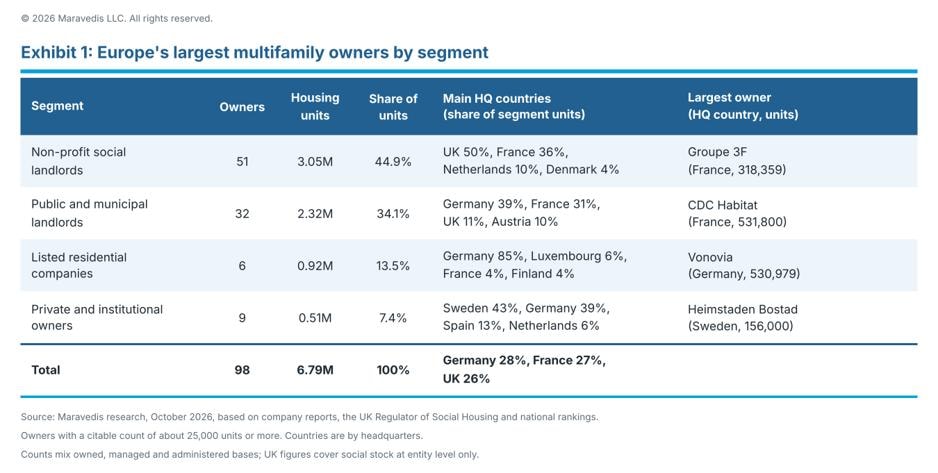
Europe's largest apartment portfolios belong mostly to social and public landlords, not to yield-driven REITs. In Maravedis research on Europe's biggest multifamily owners, social and public landlords hold about 79% of the 6.8 million units we could count. Anyone selling fibre, managed Wi-Fi or smart building technology into European MDUs needs to start from that fact.
In the U.S., the largest multifamily owners are mostly REITs, private equity platforms and developer-operators. They buy connectivity as an amenity and a revenue line. In Europe, the buyer is more often a housing association, a municipal company or a state-backed group with a social mandate, regulated rents and a 30-year asset horizon. Ownership structure decides who signs, how the deal is financed and what the resident pays.
Renting is also far more central to European life. According to the OECD's Society at a Glance 2024, 55% of households in Germany rent, and Denmark, Austria and the Netherlands each have more than 40% of households renting.
So who are these owners? Below, we break Europe's top landlords into four segments, using Maravedis's research on Europe's largest multifamily owners. Many of these landlords are exactly the people we are bringing to RISER, our summit on connectivity and building technology for residential real estate, in Amsterdam on 6 to 8 April 2027.
The big picture: 98 owners, 6.8 million homes
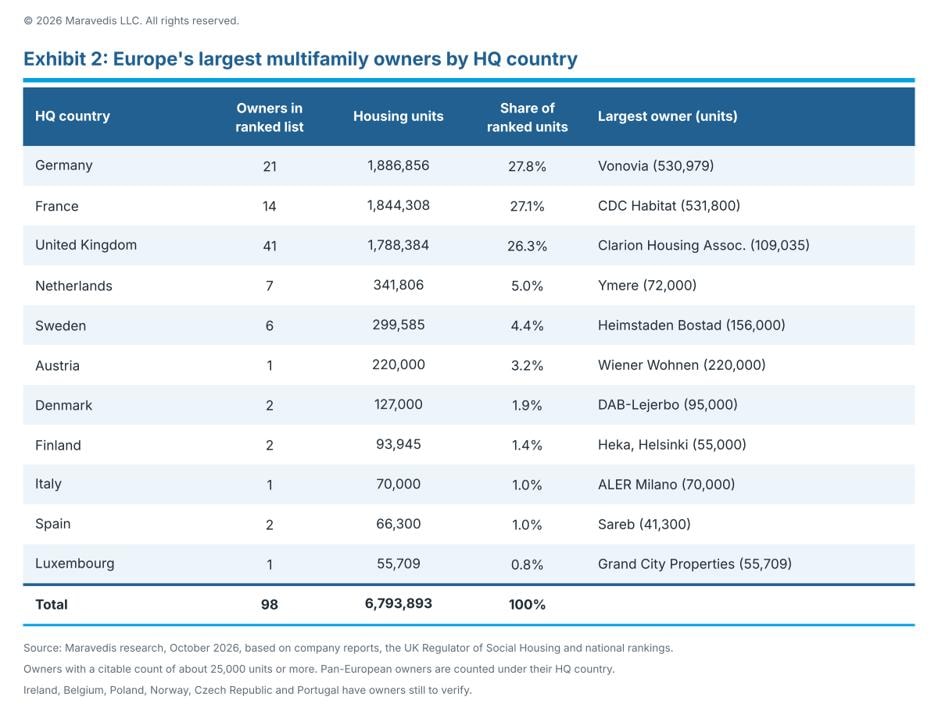
We ranked 98 European owners with a citable count of roughly 25,000 units or more. Together they hold or manage 6.79 million homes. Three countries dominate: Germany (27.8% of ranked units), France (27.1%) and the UK (26.3%), or 81% combined.
A word on the numbers. Counts are not fully comparable: most are units owned, but some French groups publish units managed, and two Danish entries administer homes owned by independent associations. UK figures cover social stock at entity level only, so group totals run higher. Treat the shares as directional, not exact.
Segment 1: Non-profit social landlords (45% of units)
The largest segment is the non-profit social housing sector: 51 owners and about 3.05 million homes. It has three national flavours.
UK housing associations
Clarion (109,035 social homes; about 125,000 across all tenures), L&Q (88,521), Peabody (79,887) and Sovereign Network Group (77,926) lead a long list. The UK alone puts 41 owners in our ranking, more than any other country.
French ESH groups
Groupe 3F (318,359 managed, including hostel places and shops), Seqens (105,000) and Domofrance (60,000+) all sit inside Action Logement Immobilier, which gives that one group about 483,000 units in our list. Polylogis (146,000), Batigère and ICF Habitat (about 100,000 each) follow.
Dutch housing corporations
Ymere (72,000) and Eigen Haard (57,000) in Amsterdam, Staedion (46,000) in The Hague and Woonstad (46,712) in Rotterdam anchor a market where many more corporations sit in the 20,000 to 40,000 range.
Denmark adds a twist: DAB-Lejerbo administers about 95,000 homes for independent housing associations, which own the buildings. The administrator is the gatekeeper, not the owner.
For connectivity, this segment buys through tenders, works under regulated rents and thinks in long renovation cycles. Digital inclusion, energy retrofits and resident satisfaction carry more weight here than amenity revenue.
Demand is running far ahead of supply. Housing Europe's State of Housing in Europe 2025 puts construction at a decade low and estimates that France needs 518,000 homes a year (198,000 of them social), Germany 400,000, and the Netherlands about 1 million by 2031. Every new or renovated block is a chance to build fibre and Wi-Fi in from day one. How housing associations and corporations tender and fund those upgrades is one of the conversations we want to have at RISER.
Segment 2: Public and municipal landlords (34% of units)
Cities, regions and state-backed groups make up the second segment: 32 owners and about 2.32 million homes. This is where Europe's single largest portfolios live.
CDC Habitat
France, part of Caisse des Dépôts — manages about 531,800 homes in all tenures, of which about 351,000 are social units. It is the largest owner in our ranking.
Wiener Wohnen
Owns about 220,000 homes for the City of Vienna and is often cited as Europe's largest single landlord.
Hamburg's SAGA and Paris Habitat
SAGA (140,027) and Paris Habitat (126,724) show how much housing one city can concentrate in one company.
Berlin's state-owned companies
degewo, HOWOGE, Gewobag, Stadt und Land, Gesobau and WBM together hold about 377,000 homes in our list.
The list also includes UK councils such as Birmingham (56,841) and Leeds (51,808), Helsinki's Heka (55,000) and Stockholm's municipal companies. One decision at one of these entities can cover a whole city's stock. The trade-off is public procurement rules, political oversight and longer sales cycles. RISER gives vendors and operators a rare chance to meet these municipal buyers outside a formal tender.
Segment 3: Listed residential companies (14% of units)
Only six listed companies make our ranking, but they hold about 920,000 homes, and one of them is a giant.
Vonovia
Owns 530,979 units, including 471,153 in Germany, plus Victoriahem in Sweden and BUWOG in Austria.
LEG Immobilien and TAG Immobilien
LEG (171,360) and TAG (83,504, plus build-to-rent in Poland) follow in Germany.
Grand City Properties, Covivio and Kojamo
Grand City Properties (55,709 German units, part of Aroundtown), Covivio's German residential arm (about 40,000) and Finland's Kojamo (38,945) complete the group.
This is the segment that behaves most like a U.S. owner. It returns capital, runs portfolio-wide technology programs, and negotiates directly with network operators. In Germany, the end of cable TV billing through tenants' ancillary costs in July 2024 pushed these landlords to rethink how they fund in-building networks. We expect those funding models to be a hot topic in Amsterdam at RISER.
Segment 4: Private and institutional owners (7% of units)
The smallest segment by counted units is also the most varied: nine owners and about 506,000 homes.
Pan-European private landlords
Heimstaden Bostad owns more than 156,000 homes across nine countries, from Sweden and Norway to Germany, the Netherlands, Poland and the UK.
Foundation and corporate owners
Vivawest (118,656 units in North Rhine-Westphalia, backed by the RAG Foundation) and Helaba's GWH (about 50,000) in Hesse.
Pension money
Willhem (about 31,000, owned by Sweden's AP3 and AP4 funds), Rikshem (about 29,000) and Vesteda in the Netherlands (about 27,800).
Banks and workout vehicles
Spain's Sareb (41,300) and CaixaBank (about 25,000), where not every unit is rented.
This segment is under-counted. Greystar Europe, Blackstone's European residential platforms, Round Hill Capital, Patrizia and Poland's Resi4Rent do not publish unit counts we could compare, so they sit on our verification list. They also run the build-to-rent, student and co-living assets that look most like U.S. Class A multifamily. That makes them the natural early adopters of amenity-led managed Wi-Fi in Europe.
Capital is moving toward this segment. JLL data show European residential investment rose 22% to €62.2 billion in 2025.
What it means for operators and vendors
Europe's MDU opportunity is concentrated, but it is not a U.S. playbook with a new accent. Four lessons stand out.
1.Sell programs, not buildings.
A few hundred decision-makers control millions of homes. One framework agreement with a housing group or a city company can reach more units than years of building-by-building sales.
2.Match the business model to the owner.
Social and public landlords care about affordability, inclusion and lifecycle cost. Listed and institutional owners care about yield and asset value. The same network can be pitched two very different ways.
3.Follow the capital cycle.
Energy retrofits, fibre rollouts and portfolio refinancing are the moments when in-building networks get budgeted. Timing matters as much as product.
4.Mind the gaps.
Italy, Spain, Belgium, Ireland, Poland and Central Europe have many owners in the 20,000 to 40,000 range with no current public count. The next wave of opportunity is there, and few vendors have mapped it.
Two signals make the timing better. The European Commission's first European Affordable Housing Plan (16 December 2025) proposes a pan-European investment platform for affordable and sustainable housing with the European Investment Bank, plus a European Housing Summit in 2026. And fibre take-up still lags in several large rental markets: FTTH/B penetration is 13.8% in Germany, 13.2% in Austria and 11.8% in Belgium, against 38.0% in the UK and 39.4% in the Netherlands, according to Fibre Council Europe and IDATE. Each of these four lessons comes down to owners and connectivity providers understanding each other, which is exactly why we built RISER.
Meet the owners at RISER, Amsterdam, 6 to 8 April 2027
The owners in this ranking rarely show up at telecom trade shows, and network operators rarely show up at housing conferences. RISER™ was built to put them in the same room.
RISER is the European summit on connectivity and building technology for residential real estate, produced by Maravedis with HanseCom Media & Communication and endorsed by Fibre Council Europe (formerly FTTH Council Europe) and the World Broadband Association. We expect about 300 participants in Amsterdam, roughly half of them property owners and asset managers and half from the connectivity and technology side.
- Call for speakers is open. If you run housing, digital or asset strategy at a European landlord, or you have deployed networks in apartment buildings, we want your story on stage.
- Sponsorship is open. Operators, vendors and service providers who want direct access to Europe's largest residential owners should talk to us now.
Sources
- Eurostat, Housing statistics — dwelling stock by type of building, 2023 reference year.
- Maravedis, Europe's Largest Multifamily Owners, internal research, 2026.
- OECD, Society at a Glance 2024, Chapter on housing.
- Housing Europe, The State of Housing in Europe 2025.
- JLL, European Residential Investment Report, 2025.
- European Commission, European Affordable Housing Plan, 16 December 2025.
- Fibre Council Europe / IDATE, FTTH/B Market Panorama, 2026 edition.